How to Start Homesteading From a Small Backyard | You Don't Need Acres
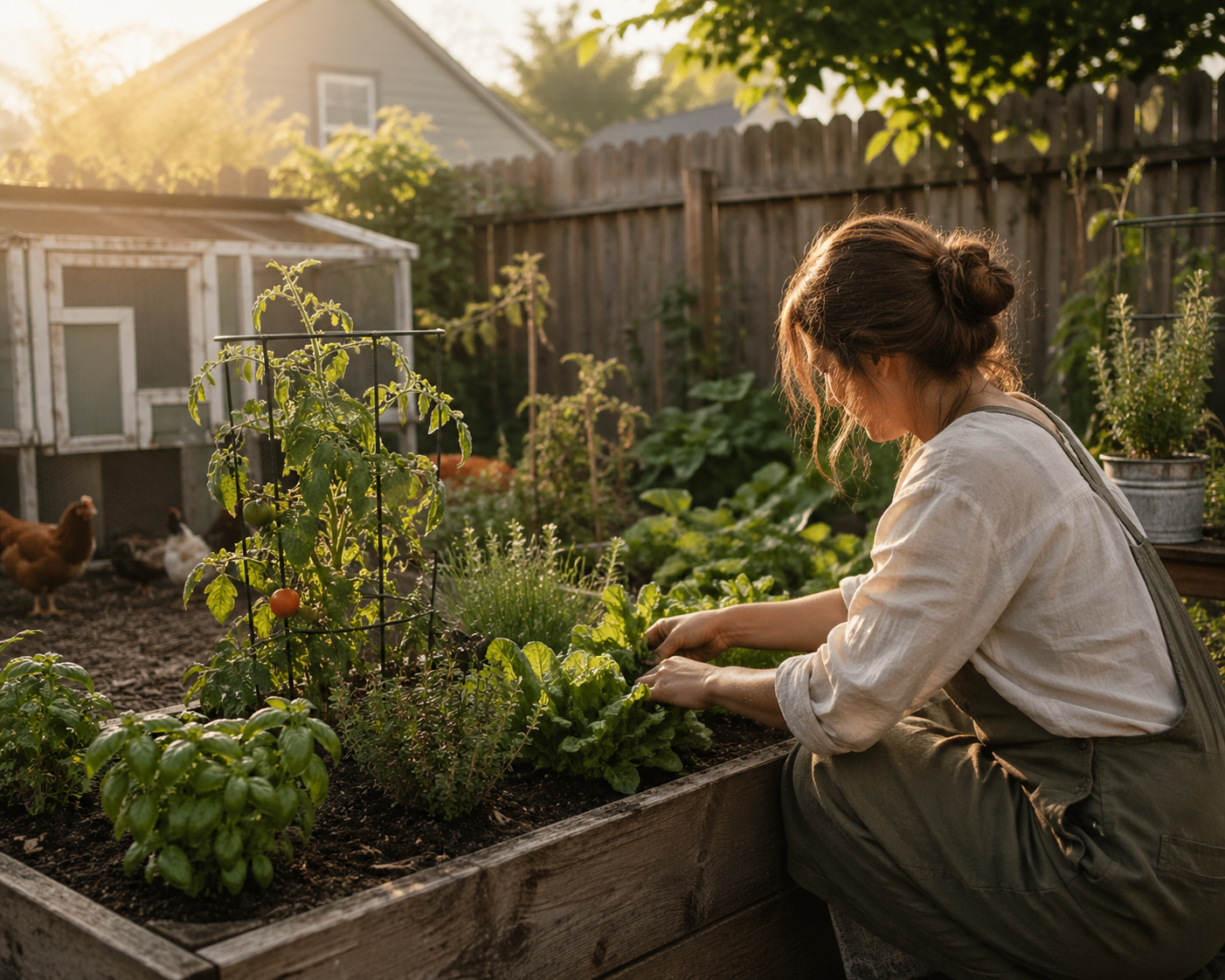
You've felt the pull. Something deep and quiet that rises up when you see someone harvesting tomatoes from their garden, or gathering eggs from a backyard coop, or putting up jars of preserves for winter. Something in you says — I want that. I want to live closer to where food comes from. I want my hands in the dirt and my family fed from something I grew.
And then you look out your back window at your small suburban yard and think, but I don't have enough space for that.
Friend, I want to gently push back on that thought today. Because the question most people are asking, how do I start homesteading if I only have a small backyard, has a much more encouraging answer than you might expect. You do not need acres. You do not need a farmhouse or a barn or a tractor or land that stretches past the tree line.
You need what you already have. A small piece of ground, a willing pair of hands, and a God who has always been in the business of doing extraordinary things with ordinary plots of soil.
What Is Homesteading, Really?
Before we talk about where to start, it helps to clear up what homesteading actually means, because it has collected a lot of romantic imagery that can make it feel inaccessible before you even begin.
Homesteading is not a aesthetic. It is not a Pinterest board or a specific number of acres or a particular style of farmhouse. At its core, homesteading is simply the practice of producing more of what you consume, growing food, preserving it, raising animals, reducing dependence on systems outside your home, and doing it with intention and care.
That definition fits a fifty-acre farm. And it fits a quarter-acre suburban lot. The scale is different. The heart is the same.
And the heart, for those of us who follow Christ, goes even deeper than self-sufficiency. It goes all the way back to the beginning.
The Biblical Case for Growing Your Own Food
Genesis 2:15 says that God placed man in the garden to work it and keep it. Before the fall, before the curse, before anything else, human beings were gardeners. Stewards of the earth. Tenders of growing things.
"The Lord God took the man and put him in the Garden of Eden to work it and take care of it." — Genesis 2:15
That calling did not disappear when we moved to the suburbs. The impulse you feel toward growing things, toward feeding your family from the ground, toward knowing where your food comes from, that is not a trend. That is something ancient and God-given stirring in you.
Homesteading, at its best, is an act of stewardship. It is saying: God has given me this piece of ground, this plot, this yard, however small, and I am going to tend it well. I am going to use it. I am going to bring life out of it and feed the people I love with what it produces.
That is not a hobby. That is a calling.
Read Now: Your Home Is a Ministry: What the Bible Says About Keeping House
What Can You Actually Do With a Small Backyard?
More than you think. Here is what is genuinely possible in a modest suburban space, and where to begin with each one.
Raised Bed Gardening — Start Here First
If you do nothing else this season, build or buy one raised bed and plant it. A single 4x8 raised bed filled with good soil can produce a remarkable amount of food, lettuce, herbs, tomatoes, cucumbers, beans, radishes. One bed is enough to learn on, enough to feed your family fresh greens through the growing season, and enough to get your hands in the soil and feel what this life is actually like.
Raised beds are the single best entry point for suburban homesteading because they are contained, manageable, productive quickly, and forgiving for beginners. You do not need to tear up your entire yard. You need four boards, some good soil, and seeds.
Start with what your family actually eats. There is no point growing kohlrabi if no one at your table will touch it. Grow tomatoes. Grow zucchini. Grow herbs like basil, parsley, and chives, because fresh herbs transform ordinary cooking and they grow almost effortlessly.
A Kitchen Herb Garden — Even If You Have No Yard At All
If your outdoor space is truly minimal, a small patio, a narrow strip of lawn, even just a sunny windowsill, start with herbs. A few pots of rosemary, thyme, basil, and mint on a kitchen windowsill is the beginning of a from-scratch kitchen. It costs almost nothing, produces immediately, and connects your cooking to something living and tended.
[LINK: related post — How to Grow Herbs Indoors for Cooking and Healing]
Backyard Chickens — More Accessible Than You Think
Backyard chickens are one of the fastest-growing homestead trends of 2026, and for good reason. A small flock of three to four hens requires surprisingly little space, produces fresh eggs consistently, and brings a rhythm and aliveness to a backyard that is genuinely wonderful.
Before you dive in, check your local ordinances, many suburban areas allow hens but not roosters, and there are often limits on flock size. Once you know what is permitted, the setup is simpler than most people expect. A small coop, a secure run, quality feed, fresh water, and a little daily attention is genuinely all it takes.
There is something deeply good about going to the backyard each morning to collect eggs. About feeding your family protein that came from animals you have cared for, animals that have names and personalities and have been tended well. It connects you to the food chain in a way that a grocery store simply cannot.
Composting — The Foundation of Everything
If homesteading is about bringing life from the ground, composting is where that life begins. Kitchen scraps, garden waste, coffee grounds, eggshells, all of it can become rich, dark compost that feeds your soil and grows better food.
A simple compost bin in the corner of your yard takes fifteen minutes to set up and costs almost nothing. It is the most unglamorous entry point into homesteading and also one of the most important. Healthy soil grows healthy food. And healthy food nourishes healthy families. The whole chain starts in that humble pile of scraps.
Food Preservation — Extending the Harvest
Once you start growing food, you will quickly discover that gardens are generous. They give abundantly and all at once. Learning to preserve that abundance, to can tomatoes in August so you have them in January, to freeze summer berries, to ferment vegetables, to make jam from the fruit that comes faster than you can eat it, is the other half of the homesteading equation.
You do not need a pressure canner to start. Water bath canning is sufficient for high-acid foods like tomatoes, jams, and pickles. A large pot, some mason jars, and a simple beginner's guide is enough to get started. And there is a deep satisfaction in opening a jar of something you grew and preserved yourself in the middle of winter that is genuinely difficult to describe until you have experienced it.
The Mindset Shift That Makes All the Difference
Here is where most beginner homestead content misses it entirely, and where this blog wants to offer something different.
The biggest barrier to starting is not space. It is not money or time or skill. It is the belief that what you have is not enough. That your small yard is not a real homestead. That you are playing at something rather than actually doing it.
That belief is a lie, and it is worth naming it plainly.
God does not ask you to steward what you do not have. He asks you to steward what you do. The five talents and the two talents and the one, all of them were given to be used, not held in reserve until the conditions were more favorable.
"Whoever can be trusted with very little can also be trusted with much." — Luke 16:10
Your small backyard is not a consolation prize. It is your beginning. Tend it faithfully. Learn on it. Produce from it. Let it teach you what growing things requires, patience, attention, humility, and the willingness to try again when something fails.
And trust that faithfulness with a small plot is exactly the kind of stewardship that honors the God who gave it to you.
Where to Begin — A Simple First Season Plan
If you are standing at the beginning and need a clear place to start, here it is. Not everything at once. One faithful step at a time.
This week: Order or buy seeds for three to five vegetables your family loves. Tomatoes, cucumbers, basil, and lettuce are ideal for beginners. If you can, order them from a reputable heirloom seed company so you can eventually save seeds from your harvest.
This month: Build or purchase one raised bed. Fill it with a quality garden mix, not straight topsoil, which compacts. A blend of compost, peat, and vermiculite drains well and gives your plants what they need to thrive.
This season: Plant your bed, tend it faithfully, and pay attention. Water consistently. Watch for pests. Learn what your plants are telling you. Let this first season be your education.
This year: Set up a simple compost system. Research your local ordinances on backyard chickens. Preserve something from your harvest, even one batch of jam or one jar of pickles. Let each small success build your confidence for the next step.
You Are Already a Steward — Start Acting Like One
The homestead life is not reserved for women with acreage and a barn full of animals. It is available to any woman who is willing to tend what she has been given, however small, however modest, however imperfect the beginning.
Your backyard is enough to start. Your desire to grow things, to feed your family from the ground, to live closer to where food comes from, that desire is worth honoring. It is worth acting on. Not someday when you have more space or more money or more time. Now. This season. With what you have.
"The earth is the Lord's, and everything in it." — Psalm 24:1
The ground under your feet, even the small suburban patch of it, belongs to God. He has entrusted it to you. And He is not waiting for you to have a bigger plot before He considers you a faithful steward.
Start small. Start now. Start where you are.

- https://www.nrcs.usda.gov/resources/guides-and-instructions/soil-health
- https://extension.umn.edu/planting-and-growing-guides
- https://www.almanac.com/gardening
- https://extension.psu.edu/raised-bed-gardening
- https://agrilifeextension.tamu.edu/library/gardening/
- https://www.backyardchickens.com/articles/
- https://www.thespruce.com/urban-gardening-4171931
- https://nchfp.uga.edu/how/can_home.html
- https://www.epa.gov/recycle/composting-home
- https://www.seedsavers.org/learn
- https://www.reddit.com/r/homestead/comments/15l9v0x/how_to_start_homesteading_in_suburbs/
- https://www.reddit.com/r/gardening/comments/13x8y1q/small_backyard_garden_success/
- https://www.reddit.com/r/BackyardChickens/comments/14m7c6h/starting_with_3_hens_advice/
- https://www.reddit.com/r/composting/comments/12abcde/beginner_compost_setup_help/
- https://www.reddit.com/r/UrbanFarming/comments/16xyz12/what_can_i_grow_in_small_space/
Comments