How to Build a 3-Month Food Supply for Your Family: A Faith-Rooted Beginner's Guide
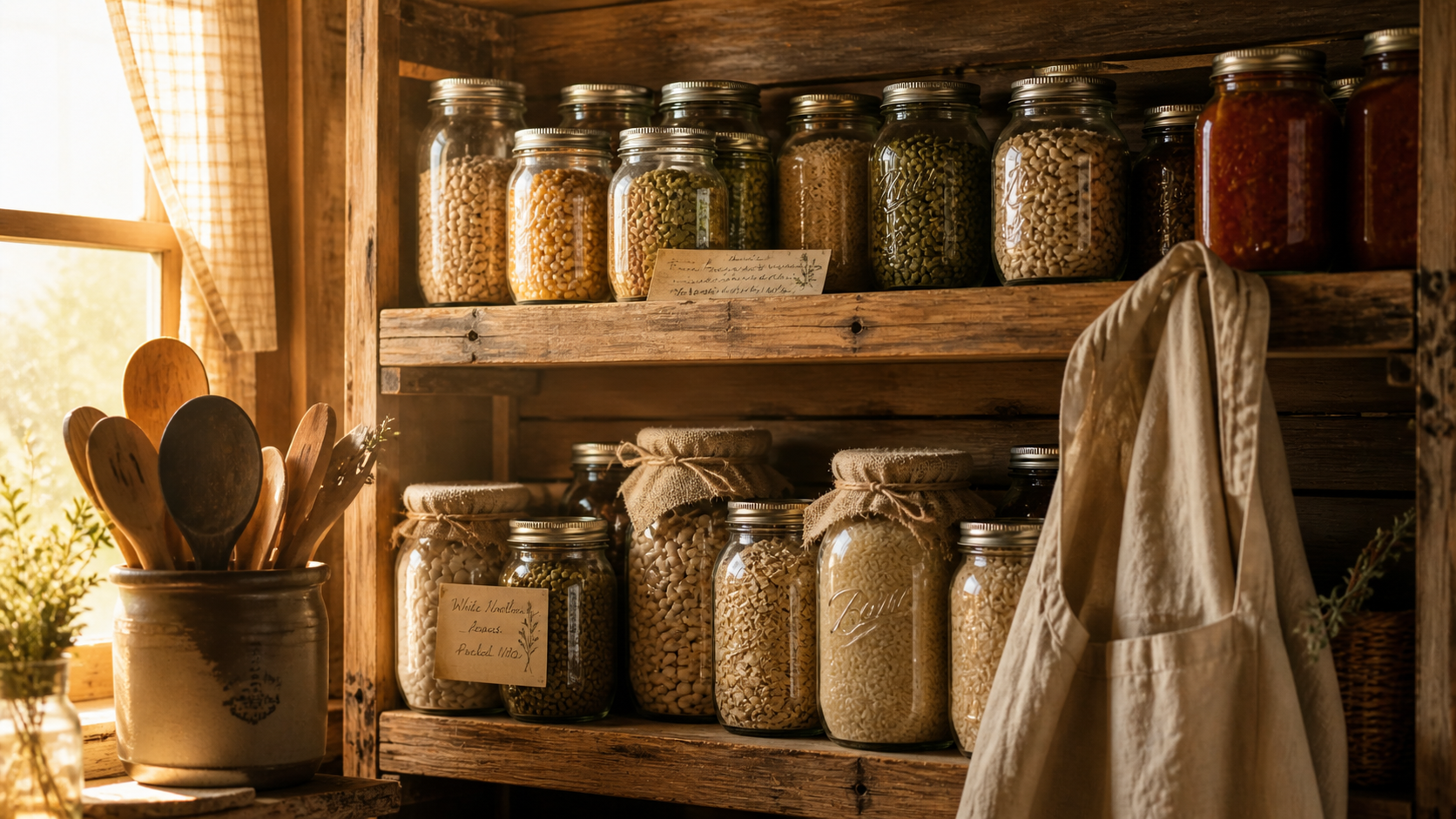
There is something steadying about a full pantry.
Not the kind you curate for Instagram, the kind where the shelves hold real food, the kind that will actually nourish your family if the week goes sideways. Bags of oats. Jars of dried beans. Rice in a sealed container. Canned tomatoes stacked two deep.
That pantry doesn't happen by accident. It's built, quietly and faithfully, by a woman who decided that caring for her household meant looking further than next Tuesday.
If you've been meaning to build a real food storage and don't know where to begin, you're in the right place. This is not about fear. It's about love, wisdom, and the quiet work of keeping a home well.
A 3-month food supply is a rotating pantry of shelf-stable staples that could sustain your household for approximately 90 days without a grocery run. It is not a bunker full of freeze-dried pouches. It is simply an intentional extension of what you already keep in your kitchen, more of the real foods your family eats, stored wisely, replenished regularly.
As a general starting point, nutritionists and emergency preparedness resources suggest planning for roughly 2,000 calories per adult per day, adjusted for children's ages, activity levels, and any dietary needs your family has. For a family of four with two adults and two children, a realistic 3-month supply means approximately 700 to 800 pounds of food total, though you'll build toward that number slowly, over months, without pressure.
Scripture does not leave us guessing here. Proverbs 6:6–8 describes the ant who gathers her food in summer and stores her provisions at harvest, not because she is afraid, but because she is wise. She reads the seasons. She plans ahead. She acts before the need arrives.
First Timothy 5:8 is even more direct: "But if anyone does not provide for his relatives, and especially for members of his household, he has denied the faith and is worse than an unbeliever." Provision is not optional. It is an expression of our faith made tangible in the home.
Building a food supply for your family is not hoarding. It is not anxiety dressed up in productivity. It is faithful stewardship, tending the resources God has given you, with wisdom and love, so that your household is not left wanting when hard seasons come.
Read Now: Beginner Emergency Preparedness for Christian Families
Because most of the resources out there start too big and speak too clinically. They hand you a spreadsheet with 1,200-calorie calculations, tell you to buy a year's supply, and leave you staring at the screen wondering how you'll afford it or where you'd even put it.
The overwhelm is not a character flaw. It's a natural response to being handed the wrong tools. A 3-month food pantry is built one extra can at a time, not all at once. It grows the way a garden grows, steadily, with regular tending, yielding more than you put in.
Start where you are. Buy one extra bag of rice this week. That's enough.
Yes, and honestly, you should. The best food storage is made up of foods your family already eats. Freeze-dried emergency rations are expensive, unfamiliar, and often sit untouched because no one actually wants to eat them when things are fine.
A rotating pantry of whole grains, dried legumes, canned goods, fats, and shelf-stable proteins is far more practical, far more affordable, and far more nourishing. You buy more of what you already use. You rotate it into your weekly cooking. Nothing expires unnoticed on a forgotten shelf.
This is the way women kept homes for centuries, not with tactical supplies, but with a well-stocked larder and the wisdom to use it.
Start with the foods that anchor your family's everyday meals. Think about what you actually cook, not what you think you should be eating. If your family lives on pasta, beans, and rice, that is your foundation. If you make a pot of soup every Sunday, your pantry should hold the makings of fifty more.
The core categories of a well-built food pantry:
Read Now: How to Grow Herbs Indoors for Cooking and Healing
The most important thing to understand is that you do not build a 3-month pantry in one shopping trip. You build it the way you build anything worth having, steadily, wisely, over time.
Here is a simple method that works:
This rhythm is slow. It is meant to be. The woman who tends her home well does not rush through it.
I want to say something that the preparedness community rarely says: a well-stocked pantry changes how you feel in your home.
There is a quiet confidence that comes from knowing your shelves are full. A kind of peace. When the news is loud or the week is hard, the pantry is steadying. It says: we are provided for. We are not afraid.
That is not a small thing. That is the fruit of faithful, unhurried work, the kind of work that Proverbs 31 describes not as drudgery, but as the work of a woman who is strong and dignified and not afraid of the future.
Your pantry is a form of love. Build it slowly. Build it well.
And when you're ready to go deeper, I'd love to share more about cooking from scratch, preserving the harvest, and turning your kitchen into the heart of a truly nourishing home. Come join us on the email list, it's a quiet, faithful little corner of the internet, and there's always room at the table.
What Is a 3-Month Food Supply and How Much Food Does My Family Actually Need?
What Does the Bible Say About Storing Food and Providing for Your Family?
Why Does Building a Food Pantry Feel So Overwhelming When I Know I Should Do It?
Can I Build a 3-Month Food Supply Without Buying Expensive Prepper Food?
How Do I Know What Foods to Stockpile for My Family's Emergency Pantry?
How Do I Start Building a 3-Month Food Storage When I'm on a Budget?
The Pantry Is More Than Preparation
Read Now: Beginner Emergency Preparedness
Comments