Rhodiola (Rhodiola rosea) forms the foundation of Brain Fog Clarity.
Sometimes called golden root or roseroot, rhodiola grows naturally in cold mountainous and northern regions of Europe, Asia, and North America.
It has a particularly interesting history within northern European and Asian herbal traditions.
In modern herbalism, rhodiola has become one of the better-known botanicals classified as an adaptogen—a modern category used for certain herbs associated with resilience during periods of physical and mental demand.
Its root contributes an earthy, somewhat bitter botanical character that gives this tea more depth than a simple peppermint blend.
ROSEMARY
Rosemary (Salvia rosmarinus) provides one of the brightest aromatic notes in the formula.
Its distinctive fragrance is immediately recognizable: green, sharp, resinous, and unmistakably Mediterranean.
Rosemary has been used for generations in cooking, household preparations, gardens, folklore, and traditional herbalism.
Its long cultural association with remembrance also gives it an especially fitting place in a blend built around the ritual of clearing away a foggy day.
Here, rosemary cuts through the heavier root flavors and pairs beautifully with peppermint and orange.
PEPPERMINT
Peppermint (Mentha × piperita) gives Brain Fog Clarity its fresh, cooling character.
Its naturally aromatic leaves create the immediate brightness that rises from the cup when hot water hits the blend.
Peppermint has a long history as both a culinary and household tea herb and remains one of the world's most familiar botanical infusions.
Here, it helps transform an otherwise earthy adaptogenic formula into a much brighter and more approachable cup.
ELEUTHERO ROOT
Eleuthero (Eleutherococcus senticosus) contributes another earthy, woody layer.
Historically known in the West as “Siberian ginseng,” eleuthero is botanically distinct from true Panax ginseng.
It has a long history within East Asian herbal traditions and later became especially well known within modern adaptogenic herbalism.
Its root character complements rhodiola while allowing the more aromatic rosemary, peppermint, and orange peel to remain prominent.
ORANGE PEEL
Orange peel provides the finishing note.
Its naturally fragrant citrus oils create a warm, familiar aroma that pairs especially well with peppermint and rosemary.
Dried citrus peel has appeared in foods, beverages, spice blends, teas, and household preparations across cultures for generations.
Here, it adds brightness and subtle sweetness without relying on artificial citrus flavoring.
RHODIOLA ROOT
Rhodiola (Rhodiola rosea) forms the foundation of Brain Fog Clarity.
Sometimes called golden root or roseroot, rhodiola grows naturally in cold mountainous and northern regions of Europe, Asia, and North America.
It has a particularly interesting history within northern European and Asian herbal traditions.
In modern herbalism, rhodiola has become one of the better-known botanicals classified as an adaptogen—a modern category used for certain herbs associated with resilience during periods of physical and mental demand.
Its root contributes an earthy, somewhat bitter botanical character that gives this tea more depth than a simple peppermint blend.
ROSEMARY
Rosemary (Salvia rosmarinus) provides one of the brightest aromatic notes in the formula.
Its distinctive fragrance is immediately recognizable: green, sharp, resinous, and unmistakably Mediterranean.
Rosemary has been used for generations in cooking, household preparations, gardens, folklore, and traditional herbalism.
Its long cultural association with remembrance also gives it an especially fitting place in a blend built around the ritual of clearing away a foggy day.
Here, rosemary cuts through the heavier root flavors and pairs beautifully with peppermint and orange.
PEPPERMINT
Peppermint (Mentha × piperita) gives Brain Fog Clarity its fresh, cooling character.
Its naturally aromatic leaves create the immediate brightness that rises from the cup when hot water hits the blend.
Peppermint has a long history as both a culinary and household tea herb and remains one of the world's most familiar botanical infusions.
Here, it helps transform an otherwise earthy adaptogenic formula into a much brighter and more approachable cup.
ELEUTHERO ROOT
Eleuthero (Eleutherococcus senticosus) contributes another earthy, woody layer.
Historically known in the West as “Siberian ginseng,” eleuthero is botanically distinct from true Panax ginseng.
It has a long history within East Asian herbal traditions and later became especially well known within modern adaptogenic herbalism.
Its root character complements rhodiola while allowing the more aromatic rosemary, peppermint, and orange peel to remain prominent.
ORANGE PEEL
Orange peel provides the finishing note.
Its naturally fragrant citrus oils create a warm, familiar aroma that pairs especially well with peppermint and rosemary.
Dried citrus peel has appeared in foods, beverages, spice blends, teas, and household preparations across cultures for generations.
Here, it adds brightness and subtle sweetness without relying on artificial citrus flavoring.
 Image 1 of 3
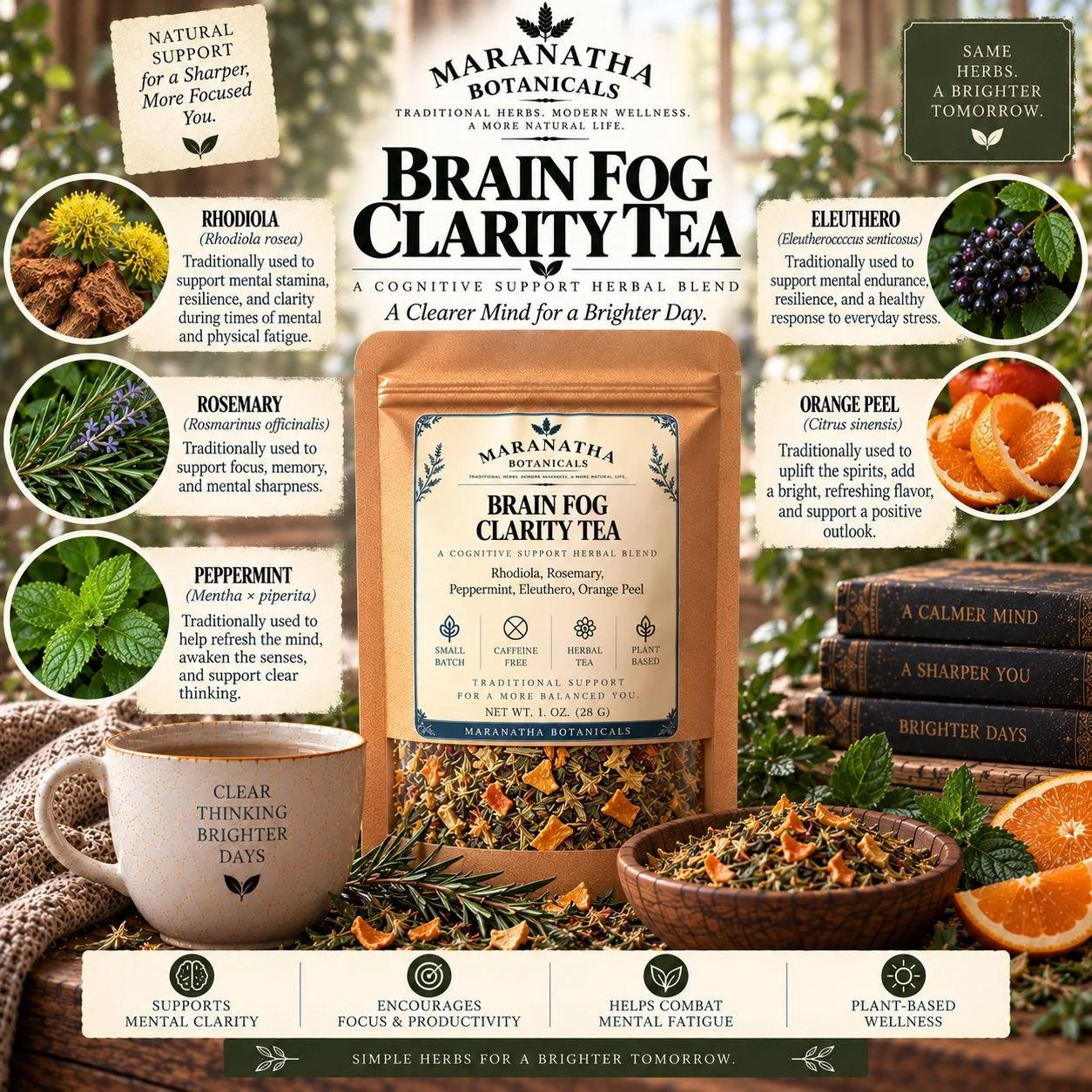 Image 2 of 3
 Image 3 of 3