Our Dreamer’s Path Tea brings together mugwort with soft chamomile, aromatic lavender, mimosa bark, and delicate rose petals in a deeply botanical loose-leaf blend inspired by traditional dreamtime and nighttime herbalism.
MUGWORT
Mugwort (Artemisia vulgaris) forms the botanical heart of Dreamer’s Path.
Few plants have accumulated quite as much folklore.
Mugwort has a long history throughout European, Asian, and Western herbal traditions and became intertwined with folk practices surrounding nighttime, dreams, and peaceful spaces.
Its reputation as a "dream herb" continues within contemporary folk-herbal traditions.
In the cup, mugwort is distinctly botanical—green, earthy, aromatic, and naturally bitter.
Rather than attempting to hide that character, Dreamer’s Path balances it with softer flowers and aromatic herbs.
CHAMOMILE
Chamomile brings softness to the formula.
Its familiar golden flowers contribute delicate floral character with subtle apple and honey-like notes that help round out mugwort's natural bitterness.
Chamomile has been enjoyed as an herbal infusion for generations and remains one of the most recognizable flowers associated with the traditional evening tea cupboard.
It provides the gentle floral bridge between earthy mugwort and aromatic lavender.
LAVENDER
Lavender contributes a distinctly aromatic floral-herbal character.
Its unmistakable fragrance has made lavender a familiar part of European household traditions for centuries, appearing in gardens, culinary preparations, baths, linens, perfumery, and traditional herbal preparations.
Lavender also carries a longstanding cultural association with nighttime rituals and the bedroom.
Here, it gives Dreamer’s Path its unmistakably fragrant character without becoming the entire flavor of the cup.
MIMOSA BARK
Mimosa bark contributes a woody, earthy dimension beneath the lighter flowers and leaves.
Mimosa (Albizia julibrissin) has a long history within traditional Chinese herbalism, where different portions of the plant have appeared in traditional preparations.
ROSE PETAL
Rose petals provide the final delicate floral note.
Rose has been cultivated for thousands of years and carries a remarkable history spanning food, perfumery, household preparations, traditional herbalism, beauty rituals, folklore, and symbolism.
Its soft fragrance complements lavender without overwhelming the earthy character of mugwort.
In Dreamer’s Path, rose is the finishing note—a little softness woven into a distinctly botanical nighttime blend.
Our Dreamer’s Path Tea brings together mugwort with soft chamomile, aromatic lavender, mimosa bark, and delicate rose petals in a deeply botanical loose-leaf blend inspired by traditional dreamtime and nighttime herbalism.
MUGWORT
Mugwort (Artemisia vulgaris) forms the botanical heart of Dreamer’s Path.
Few plants have accumulated quite as much folklore.
Mugwort has a long history throughout European, Asian, and Western herbal traditions and became intertwined with folk practices surrounding nighttime, dreams, and peaceful spaces.
Its reputation as a "dream herb" continues within contemporary folk-herbal traditions.
In the cup, mugwort is distinctly botanical—green, earthy, aromatic, and naturally bitter.
Rather than attempting to hide that character, Dreamer’s Path balances it with softer flowers and aromatic herbs.
CHAMOMILE
Chamomile brings softness to the formula.
Its familiar golden flowers contribute delicate floral character with subtle apple and honey-like notes that help round out mugwort's natural bitterness.
Chamomile has been enjoyed as an herbal infusion for generations and remains one of the most recognizable flowers associated with the traditional evening tea cupboard.
It provides the gentle floral bridge between earthy mugwort and aromatic lavender.
LAVENDER
Lavender contributes a distinctly aromatic floral-herbal character.
Its unmistakable fragrance has made lavender a familiar part of European household traditions for centuries, appearing in gardens, culinary preparations, baths, linens, perfumery, and traditional herbal preparations.
Lavender also carries a longstanding cultural association with nighttime rituals and the bedroom.
Here, it gives Dreamer’s Path its unmistakably fragrant character without becoming the entire flavor of the cup.
MIMOSA BARK
Mimosa bark contributes a woody, earthy dimension beneath the lighter flowers and leaves.
Mimosa (Albizia julibrissin) has a long history within traditional Chinese herbalism, where different portions of the plant have appeared in traditional preparations.
ROSE PETAL
Rose petals provide the final delicate floral note.
Rose has been cultivated for thousands of years and carries a remarkable history spanning food, perfumery, household preparations, traditional herbalism, beauty rituals, folklore, and symbolism.
Its soft fragrance complements lavender without overwhelming the earthy character of mugwort.
In Dreamer’s Path, rose is the finishing note—a little softness woven into a distinctly botanical nighttime blend.
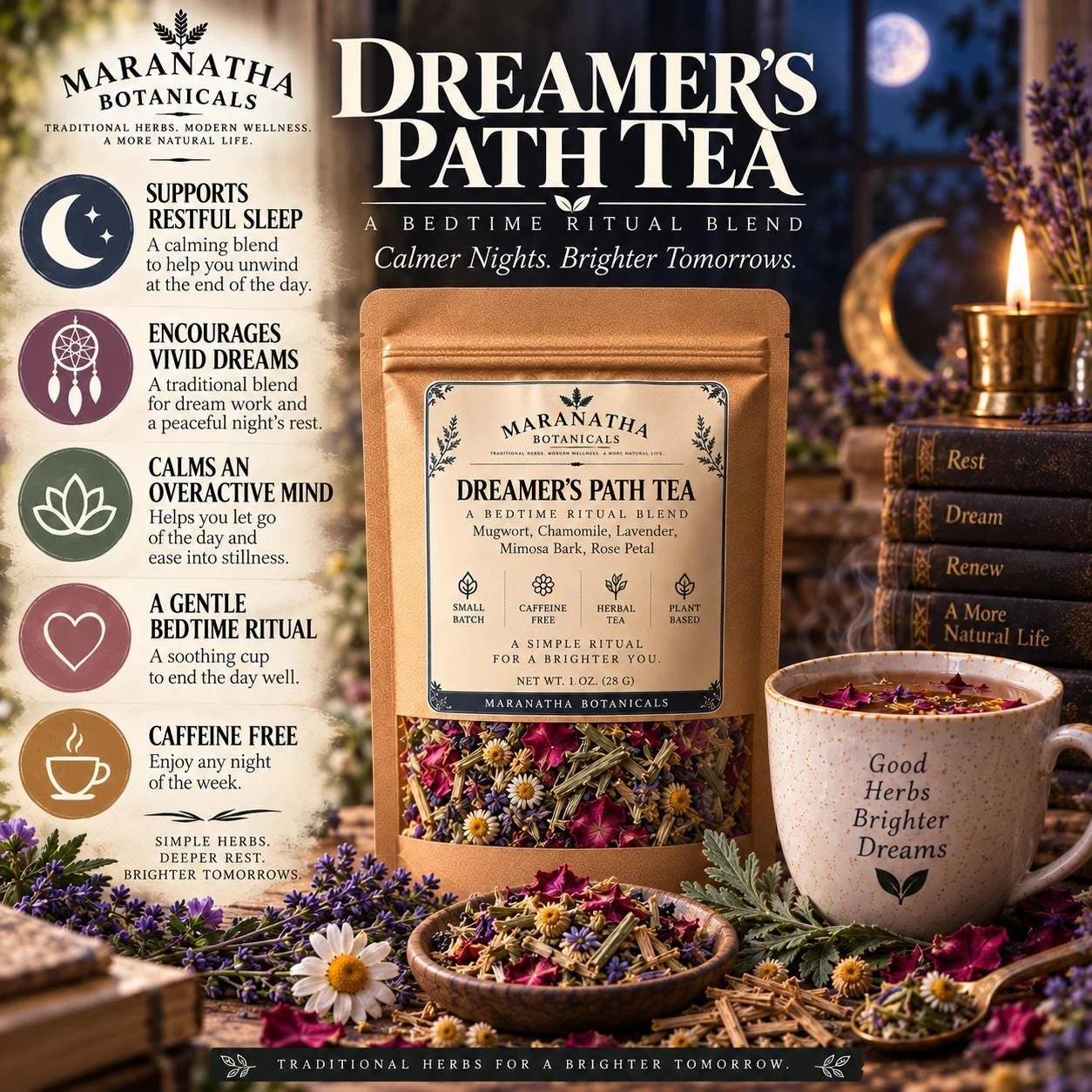 Image 1 of 3
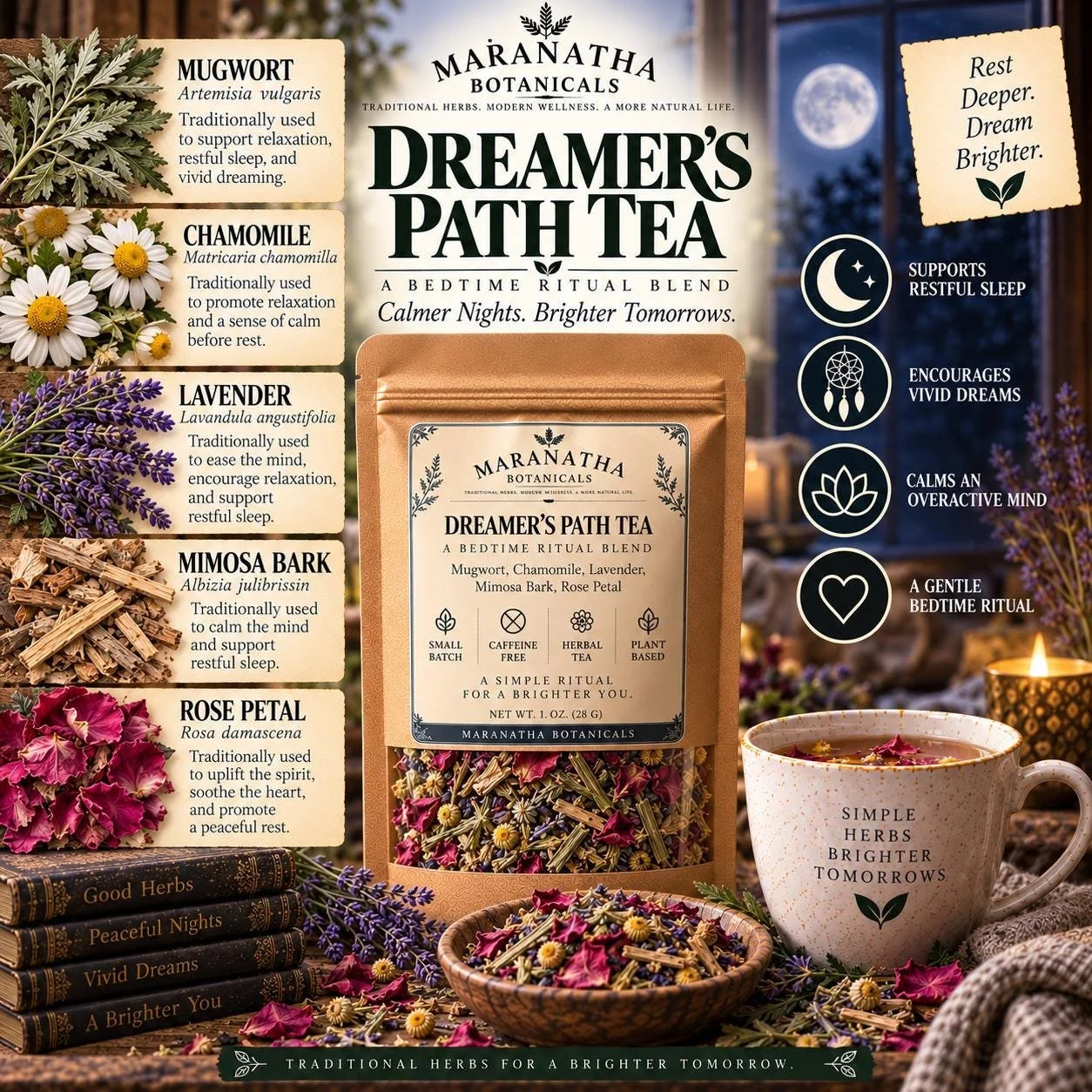 Image 2 of 3
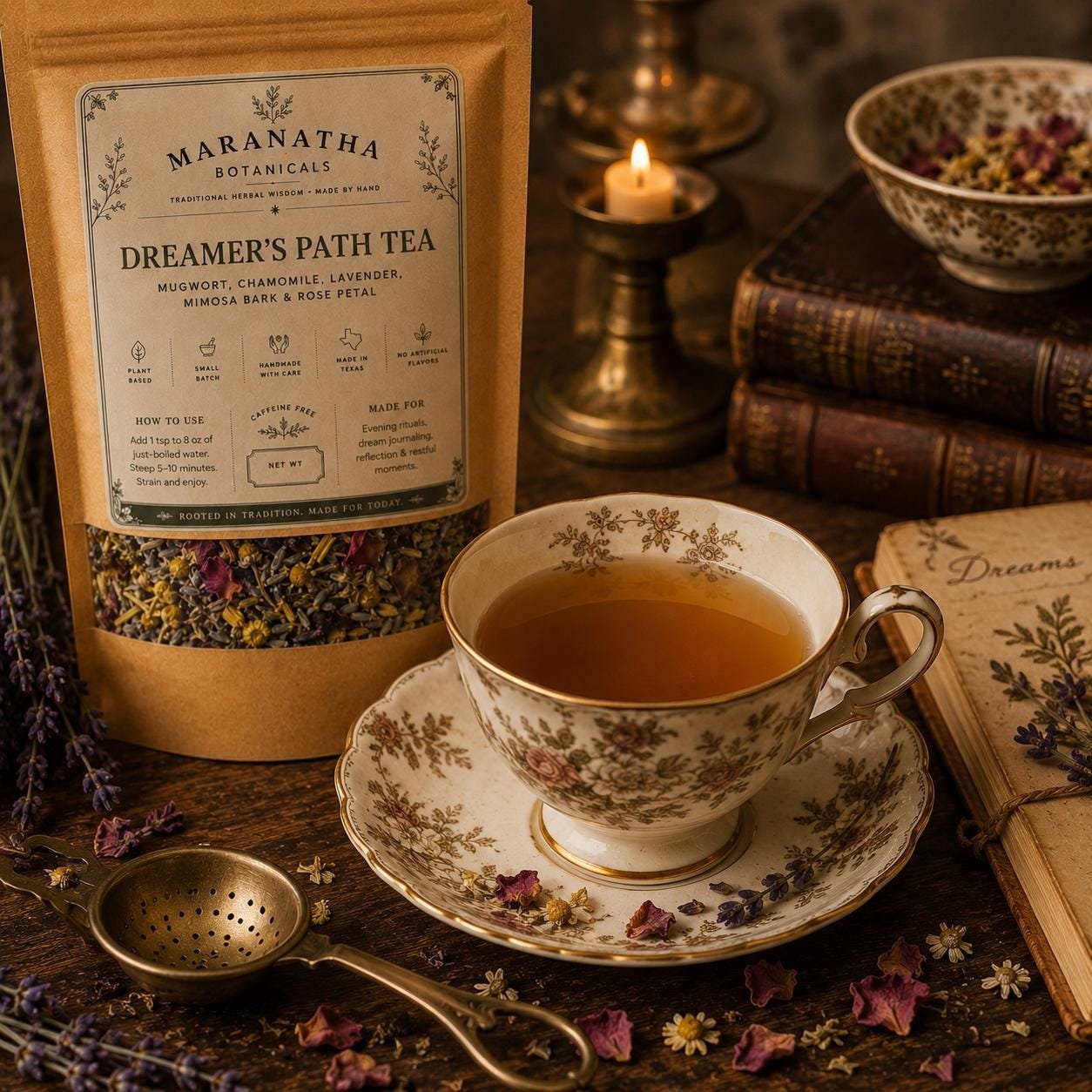 Image 3 of 3