How to Use Oxygen Absorbers for Long-Term Food Storage: Everything a Beginner Needs to Know
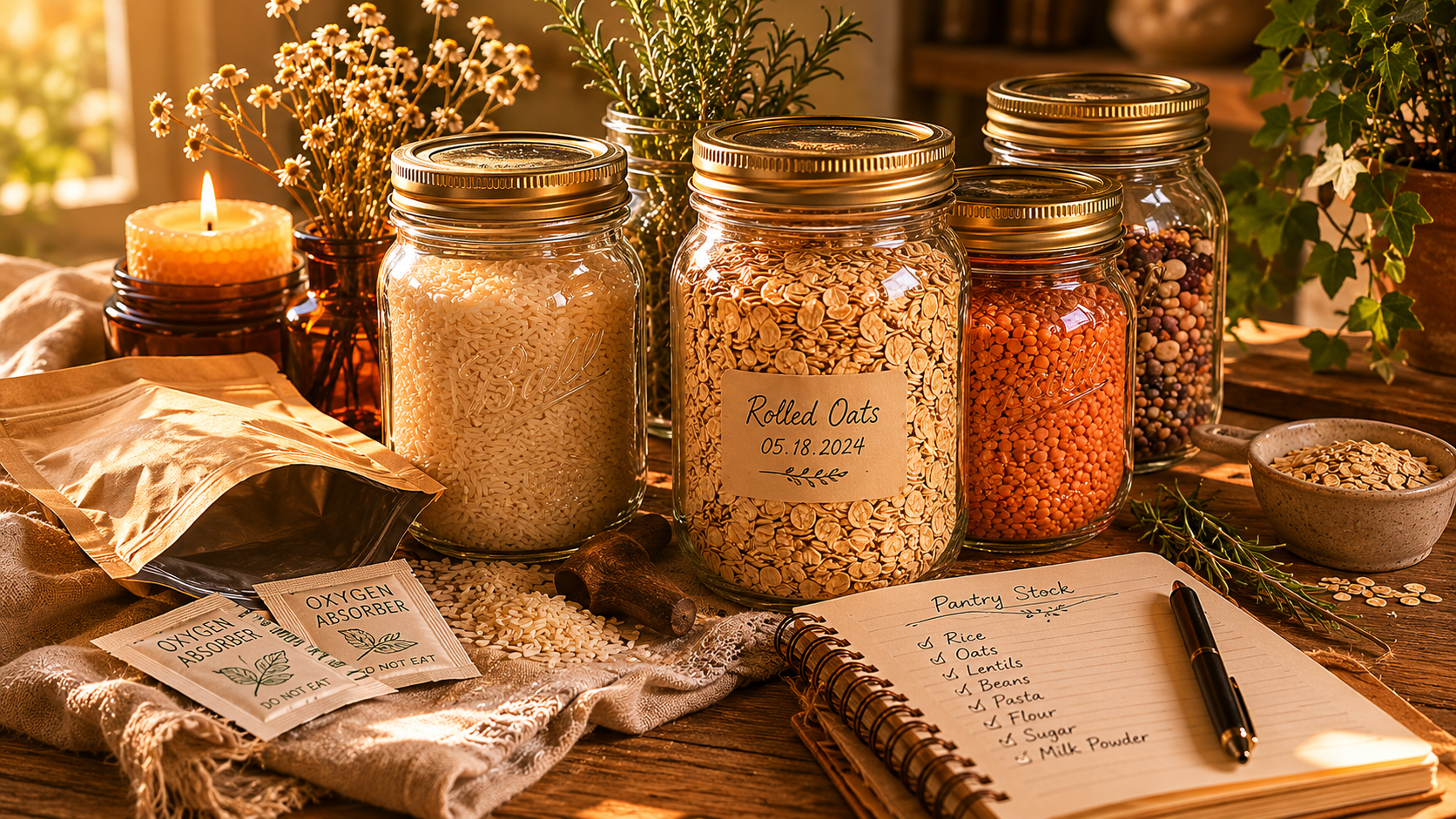
You've been building your pantry slowly and faithfully. The jars are filling up. The shelves are starting to look the way you always imagined they could. And then someone mentions oxygen absorbers and suddenly there's a new question mark hanging over everything.
Do you need them? Are they safe? What size do you buy? What happens if you use the wrong one?
These are good questions. And they deserve a clear, calm answer, not a chemistry lecture, not a survival-prepper deep dive, just the practical truth about a small tool that can make a meaningful difference in how long your food actually lasts.
Let's walk through it together.
An oxygen absorber is a small packet, usually about the size of a sugar packet, that you place inside a sealed container of dry food to remove the oxygen from the storage environment. When the oxygen is gone, the insects that would otherwise hatch in your grains can't survive, the fats that would otherwise go rancid stay stable longer, and the food itself remains closer to fresh for far longer than it would otherwise.
For everyday pantry rotation, things you use within six months to a year, you likely don't need them. But if you are building a long-term food storage with the goal of keeping dry goods stable for two to twenty-five years, oxygen absorbers are one of the simplest and most effective tools available to you. They are inexpensive, widely available, and require no special equipment beyond an airtight container.
The active ingredient inside most oxygen absorber packets is iron powder — the same basic chemistry as rust. When the packet is exposed to air, the iron oxidizes, absorbing the oxygen molecules in the process. Most packets also contain a small amount of salt, which helps activate and regulate the reaction, and sometimes a little water to initiate it. The packet itself is made of a breathable but non-permeable material that allows oxygen to pass through while keeping the iron powder safely contained.
Yes. Oxygen absorbers are completely food-safe and have been used in commercial food packaging for decades, you have almost certainly eaten food that was packed with one without knowing it. The iron powder inside does not come into contact with your food when the packet is intact. If a packet were to break open, the iron powder itself is non-toxic, though you would want to discard that packet rather than use it. The FDA considers oxygen absorbers safe for food packaging, and they are widely used in commercial products from beef jerky to vitamin supplements.
The basic process is simple: fill your airtight container with dry food, drop the appropriate number of oxygen absorbers on top, and seal it immediately. Work quickly once your packets are out of their sealed bag — they begin absorbing oxygen from the moment they're exposed to air, so every minute of unnecessary exposure is a minute of effectiveness lost.
A practical workflow for using oxygen absorbers:
Within 1 to 4 hours of sealing, you should notice your container lid pulling inward slightly — a gentle vacuum effect as the oxygen is absorbed. On rigid containers like mason jars, the lid will feel firm and slightly concave. On mylar bags, the bag will tighten noticeably against the food inside. Both are signs that your absorber is doing its job.
Yes, completely normal. The iron oxidation reaction that makes oxygen absorbers work is mildly exothermic — meaning it releases a small amount of heat as it works. A warm or slightly hot packet is actually a sign that it is active and working well. If your packet feels completely cool and shows no sign of warmth after exposure to air, it may already be spent.
Most oxygen absorbers reach their full effectiveness within 1 to 4 hours of being sealed inside a container. However, the oxygen level continues to drop gradually for up to 24 hours. For practical purposes: seal your containers, set them aside, and check the lids the following morning. A properly sealed container with an active absorber will show a clear vacuum seal — the mason jar lid will not flex when pressed, or the mylar bag will be pulled tight.
Oxygen absorbers are measured in cc (cubic centimeters), which refers to the volume of oxygen they can absorb. The size you need depends on two things: the volume of your container and the type of food inside it.
A general starting guide:
Keep in mind that whole grains and legumes have significant air gaps between the pieces — a five-gallon bucket of white rice has more free oxygen inside it than a bucket packed with flour. For loose, chunky foods, go slightly larger on your absorber. For dense powders like flour or salt, you can go slightly smaller.
No — using a slightly oversized oxygen absorber is not harmful. The absorber will simply finish its work faster and then stop reacting once all available oxygen is consumed. Many experienced pantry builders intentionally go a size up as a buffer. The only practical downside is a minor increase in cost.
This matters more. An undersized absorber will remove some but not all of the oxygen in your container, leaving conditions that can still support mold, rancidity, or insect activity over time. If you're unsure, use two smaller packets rather than one that might be insufficient. With oxygen absorbers, it is always better to overestimate than to underestimate.
Oxygen absorbers work best with dry, shelf-stable foods that have a low moisture content — generally 10% or less. This covers most of the core foods you are likely building your long-term pantry around.
Foods that benefit significantly from oxygen absorbers:
Yes — and this is important. Never use oxygen absorbers with foods that have high moisture content (above 10%), because removing oxygen from a moist environment creates anaerobic conditions that can allow Clostridium botulinum — the bacteria responsible for botulism — to grow. This applies to any food that is soft, pliable, or feels damp. If you can bend a piece of it without it snapping, it has too much moisture for an oxygen absorber.
Also do not use oxygen absorbers with:
Not effectively — and potentially harmfully with some. The fats in nuts, brown rice, and similar foods are what cause them to go rancid, and rancidity is driven more by oxidation of fats than by microbial activity. Removing oxygen helps somewhat but does not prevent rancidity in high-fat foods the way it does in low-fat grains. More importantly, if any residual moisture is present, the anaerobic environment created by the absorber can become a food safety risk. Store high-fat foods in the freezer for long-term storage, or in a cool, dark pantry for shorter-term use.
They do different jobs, and understanding the difference will help you choose the right tool for each food.
Vacuum sealing removes most of the air from a container or bag, which reduces oxygen but does not eliminate it entirely. A typical vacuum sealer leaves roughly 1% oxygen inside, not zero. It also does not prevent the residual moisture in the air from remaining. Vacuum sealing is excellent for short-to-medium term storage (weeks to a few years), for foods you rotate regularly, and for protecting against freezer burn.
Oxygen absorbers take oxygen levels down to near zero, typically below 0.01%, which is far more effective for long-term storage measured in years and decades. They work inside any airtight container, including mason jars and mylar bags, without any special equipment. They do not remove moisture, which is why pairing them with desiccant packets is sometimes a wise addition.
For your long-term pantry staples, the wheat berries, white rice, and dried beans you are storing for ten or twenty years, oxygen absorbers inside sealed mylar bags or mason jars are the stronger choice. For your everyday rotation pantry, vacuum sealing is practical and effective.
Sometimes — but not always, and never interchangeably. They serve entirely different purposes.
Oxygen absorbers remove oxygen. Desiccant packets (typically silica gel) remove moisture. They are not the same thing, they are not substitutes for each other, and in some situations they should not be used together.
For most long-term dry food storage, rice, wheat, dried beans, flour, the food should already be dry enough that a desiccant is unnecessary. In fact, adding a desiccant alongside an oxygen absorber can sometimes interfere slightly with the absorber's function, since the iron oxidation reaction requires a small amount of humidity to initiate properly.
Where desiccants add real value: in environments with high ambient humidity, or with foods that are prone to absorbing atmospheric moisture, powdered milk, freeze-dried items, dried herbs. In those cases, use both: the desiccant pulls moisture, the oxygen absorber pulls oxygen, and the food is protected from both threats. Just be sure you are using food-safe silica gel desiccants rather than industrial-grade ones.
This is one of the most common questions beginners ask — and the answer is simpler than most people expect.
An active oxygen absorber will feel soft and pliable, may feel slightly warm, and when placed in a sealed container will cause a visible vacuum effect within a few hours. A spent oxygen absorber will feel hard and rigid, like a small brick, because the iron inside has fully oxidized and can absorb nothing more.
From the outside, a spent oxygen absorber may look identical to an active one. The difference is entirely in how it feels: a fresh absorber is soft and slightly granular when you press it; a spent one is firm, dense, and inflexible. When in doubt, press it between your fingers. Soft and yielding means active. Hard as a small pebble means spent.
If you have sealed a container and the lid is not pulling down into a vacuum within 24 hours, your absorber was likely already spent before you used it. Open the container, remove the old packet, replace it with a fresh one, and reseal immediately.
Unopened, factory-sealed oxygen absorbers have a shelf life of approximately 1 to 5 years, depending on the quality of the outer packaging and storage conditions. Once the original sealed bag is opened, any unused packets begin slowly absorbing atmospheric oxygen and should be resealed immediately in an airtight container — a wide-mouth mason jar with a tight lid works perfectly. Stored this way, opened absorbers remain effective for several weeks to a few months.
Buy quantities you can realistically use within one or two pantry-packing sessions, and store the remainder in a sealed jar. Label the jar with the date you opened the original bag.
Oxygen absorbers are one of those small, unglamorous tools that quietly make everything else work better. They do not require special skills or equipment. They cost very little. And when you crack open a jar of rice five years from now and find it tasting just as it did the day you packed it — you will be glad you took the extra step.
Building a long-term pantry is an act of faithful stewardship, and every piece of knowledge you add to it is another layer of care for the people God has placed in your home.
If you found this helpful, you might enjoy the full emergency preparedness and pantry-building series here at Little House in the Pines — and there is always a place for you on the email list if you want quiet, practical encouragement delivered right to your inbox.
Further Reading:
https://nchfp.uga.edu/publications/nchfp/factsheets/storefood.htmlhttps://extension.usu.edu/preserve-the-harvest/oxygen-absorbershttps://www.fda.gov/food/food-additives-petitions/oxygen-scavengers-food-packaginghttps://www.cdc.gov/botulism/prevention/index.htmlhttps://extension.uga.edu/publications/detail.html?number=C1046https://www.ready.gov/foodhttps://www.healthline.com/nutrition/iron-deficiency-signs-symptomshttps://www.reddit.com/r/preppers/comments/oxygen_absorbers_beginners_guidehttps://www.reddit.com/r/FoodStorage/comments/oxygen_absorbers_vs_vacuum_sealhttps://www.blueletterbible.org/lexicon/h3559/esv/wlc/0-1/https://homesteadersofamerica.com/long-term-food-storage/https://beprepared.com/blogs/articles/oxygen-absorbers-guide
What Are Oxygen Absorbers and Do I Actually Need Them?
What's inside an oxygen absorber packet?
Are oxygen absorbers safe to use with food?
How Do I Use Oxygen Absorbers in My Food Storage?
Why does my oxygen absorber feel warm — is that normal?
How long does it take an oxygen absorber to work?
What Size Oxygen Absorber Do I Need?
Does it matter if I use one that's too big?
What happens if I use one that's too small?
Which Foods Should I Store With Oxygen Absorbers?
Are there foods I should never use oxygen absorbers with?
Can I use oxygen absorbers with high-fat foods like nuts or brown rice?
Are Oxygen Absorbers Better Than Vacuum Sealing?
Should I Use Oxygen Absorbers and Desiccant Packets Together?
How Do I Know If My Oxygen Absorber Stopped Working?
What does a spent oxygen absorber look like?
How long do unused oxygen absorbers last?
A Small Tool, a Faithful Pantry
How to Quickly Build a 3 Month Food Supply
Beginner Emergency Preparedness for Christian Families: Where to Start Without the Overwhelm
What Does it Mean to be a Proverbs 31 Woman in 2026?
Demonic Deliverance in the Bible and Why Christians Can Still be Affected
Comments