How to Build a Weekly Homemaking Schedule

Does your house feel like it is always slightly behind, no matter how much you do? You clean the kitchen and by dinner it is a mess again. You do laundry and somehow there is already another pile. A weekly homemaking schedule will not make your house run itself, but it will give your week a shape, so you are not starting from zero every single morning.
This guide walks you through building a real, doable weekly homemaking schedule, one that fits your actual life instead of someone else's Pinterest board.
Why a Weekly Schedule Actually Helps
Without a schedule, every day requires fresh decisions. What needs cleaning? What did I forget? What is piling up? That constant decision-making is exhausting, even on days when nothing has technically gone wrong.
A weekly schedule takes those decisions off your plate ahead of time. Instead of asking "what should I do today," you already know, because Monday has its own job, and so does every other day. Your brain gets to rest, because the thinking has already been done.
This is not about turning your home into a factory. It is about building a rhythm, one that gives you and your family more peace, not more pressure.
Different Homemaking Personalities Need Different Schedules
Before you build anything, it helps to notice how your own brain works, because not every homemaker thrives with the same kind of structure.
Some women love a detailed, hour-by-hour plan and feel calmer with more structure, not less. If that is you, a fuller schedule with specific times attached to each task might actually feel like relief rather than pressure.
Other women feel boxed in by too much detail and do better with a loose, flexible flow, just a general sense of "this is a laundry kind of day" without a rigid time attached. If detailed schedules have failed you before, this looser approach might be why.
Neither style is more spiritual, more disciplined, or more "put together" than the other. The right schedule is simply the one that matches how you actually think, not the one that looks the most impressive on paper.
Step 1: List Your Real Priorities First
Before you assign a single task to a single day, get honest about what actually matters most in your home right now. Every home is different, and your list should reflect your real life, not someone else's.
Ask yourself a few questions:
What tasks make the biggest difference in how peaceful your home feels?
What tasks do you dread most, the ones that pile up because they keep getting skipped?
What does your family actually need from you this season, not five years from now or five years ago?
Write down your top five or six priorities. This list becomes the foundation for everything else in your schedule, so do not skip this step, even though it is tempting to jump straight to the fun part of building a chart.
A real example might look like this: a clean kitchen, laundry that does not pile up, home-cooked dinners most nights, a tidy entryway, and a little time set aside for rest. Notice this list is short and specific, not a sweeping goal like "have a perfectly organized home." Specific priorities are far easier to actually build a schedule around.
Step 2: Sort Tasks by How Often They Actually Need Doing
Not every task belongs on a daily list, and treating everything as equally urgent is one of the fastest ways to burn out. Instead, sort your home's tasks into a few simple buckets.
Daily tasks are the small things that keep chaos from building up: dishes, wiping counters, a quick tidy of the living room, starting a load of laundry.
Weekly tasks are the ones that need attention regularly but not every single day: vacuuming, bathroom cleaning, changing sheets, grocery shopping.
Monthly or seasonal tasks are the bigger projects that can wait longer between rounds: deep cleaning the fridge, washing windows, rotating closets by season.
Once your tasks are sorted this way, you will notice something freeing. Most of what feels overwhelming is not actually a daily job. It just felt that way because it had no assigned time.
Step 3: Assign Tasks to Specific Days (Zone Cleaning)
This is where a lot of well-meaning schedules fall apart. If your plan is "clean the whole house every day," you will burn out by Wednesday. Instead, try what many homemakers call zone cleaning: assigning specific rooms or task categories to specific days, so you are only tackling one main area at a time.
Here is a simple example of how that might look:
Monday: Laundry and meal planning for the week
Tuesday: Kitchen deep clean (inside microwave, wipe cabinets, clean out fridge)
Wednesday: Bathrooms
Thursday: Bedrooms and closets
Friday: Living areas and grocery shopping
Saturday: Outdoor spaces, errands, or a lighter catch-up day
Sunday: Rest, and a short look ahead at the coming week
Your version does not need to match this exactly. The point is simply this: give each day one main focus, instead of asking yourself to do everything, everywhere, all week long.
Zone cleaning works so well because it matches how attention actually functions. Trying to notice every messy corner of the entire house every single day keeps your brain scanning constantly, which is tiring even when you are not actively cleaning. When only one zone is "on duty" each day, the rest of the house gets a quiet pass, and your attention gets to rest along with it. Try keeping track with a magnetic dry erase weekly planner like this one.
A Sample Weekly Homemaking Schedule
Seeing a full week laid out can help make this less abstract. Here is one complete example, combining daily anchors with the zone cleaning approach above.
Monday
Morning: Make beds, start coffee, quick Bible reading
Main task: Laundry, plan meals for the week
Evening: Five-minute living room reset
Tuesday
Morning: Same daily anchors
Main task: Kitchen deep clean
Evening: Five-minute reset
Wednesday
Morning: Same daily anchors
Main task: Bathrooms
Evening: Five-minute reset
Thursday
Morning: Same daily anchors
Main task: Bedrooms and closets
Evening: Five-minute reset
Friday
Morning: Same daily anchors
Main task: Living areas, grocery shopping
Evening: Five-minute reset
Saturday
Morning: Slower pace, family time
Main task: Outdoor spaces or a lighter catch-up list
Evening: Prep for the week ahead
Sunday
Rest day, church if that is part of your rhythm
A short, calm look at next week's plan, nothing more
Notice this schedule still has plenty of room to breathe. It is a map, not a minute-by-minute itinerary. Make quick and easy changes with a dry erase board an markers.
How This Differs From a Simple To-Do List
It is worth pausing on why a weekly schedule works differently than a daily to-do list. A to-do list starts blank every morning, which means you are making the same decisions over and over, day after day, about what matters most.
A schedule, by contrast, makes those decisions once, in advance, for the whole week. You are not asking "what should today's list include." You already know, because you decided it ahead of time, on a calmer day, instead of in the middle of a busy one. That shift, from daily decision-making to weekly decision-making, is where most of the mental relief actually comes from.
Step 4: Build In Daily Anchors
Beyond your main zone task each day, a few small daily anchors keep the whole system from falling apart the moment life gets busy. These are the non-negotiables that happen no matter what day it is.
A simple daily anchor list might include:
A short morning routine (make the bed, start coffee, a moment of prayer)
Dishes done at least once a day
A five-minute evening reset of the kitchen and living room
These small habits are what keep your home feeling cared for on the days your bigger zone task does not happen, which will happen sometimes, and that is completely normal.
Step 5: Make Your Schedule Visual
A schedule that lives only in your head is easy to forget and easy to abandon. Putting it somewhere visible makes a real difference in whether it actually sticks.
A few simple options:
Print your schedule and put it on the fridge
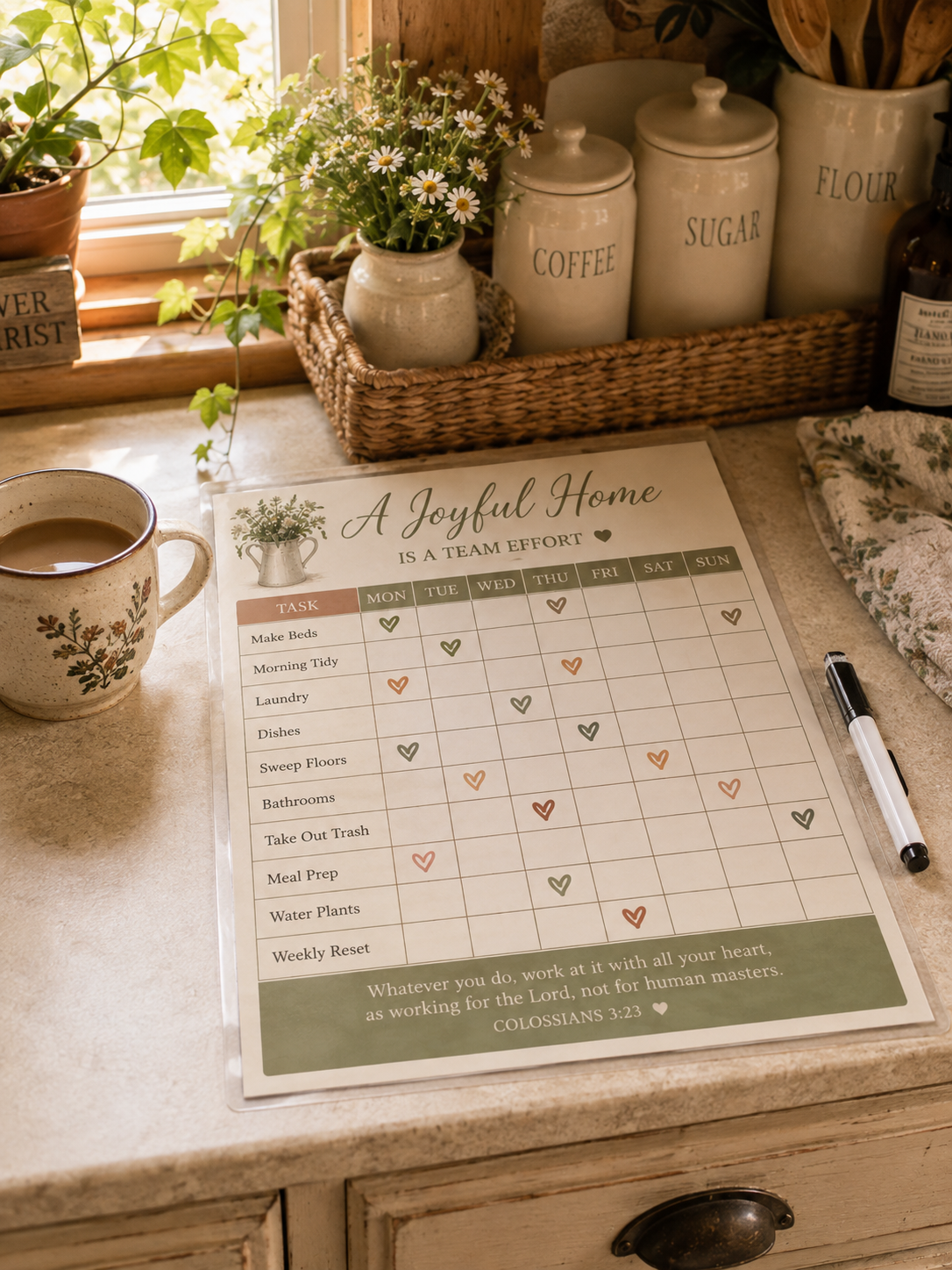
Use a laminated chart with a dry-erase marker so you can check off tasks each day
Keep it in a home management binder or planner you already use daily
Write it on a whiteboard in your kitchen or command center
The format matters far less than the fact that you can see it without having to remember it from memory.
Tools That Can Help You Stick With It
You do not need anything fancy to make a weekly schedule work, but a few simple tools can make it easier to maintain:
Alaminated weekly chart anddry-erase marker, so you can reuse it every week without reprinting
Ahome management binder with a dedicated schedule page
Asimple wall calendarwith space to jot your daily focus
A basic notes app on your phone, if paper is not your style
None of these are required. Pick whichever one you will actually look at daily, since the best tool is always the one that gets used.
What to Include If You Build a Printable Chart
If you decide to make your own printable or handwritten chart, keep it simple. A few columns are usually all you need:
The day of the week
Your one main zone or task for that day
Space for your two or three daily anchors
A small checkbox next to each item
Resist the urge to add too many columns or categories right away. A cluttered chart is just as easy to ignore as no chart at all. You can always add more detail later, once the basic version has proven itself for a few weeks.







How to Involve Your Family in the Schedule
A homemaking schedule does not have to be something you carry entirely on your own. Even young children can take on simple, age-appropriate tasks that fit into your weekly rhythm, like setting the table or putting away their own laundry.
Sharing the schedule openly, maybe posting it somewhere the whole family can see, helps everyone understand what is happening on a given day, instead of the plan living only in your head. Older kids and a spouse can often take ownership of specific days or tasks entirely, which lightens your load and helps the home feel like a shared responsibility rather than one person's invisible job.
This Looks Different in Every Season of Life
If you work outside the home, shrink your daily anchors down to the essentials, and consider spreading your zone tasks across weekends instead of weekdays if that fits your schedule better.
If you homeschool, you might build your zone cleaning around natural breaks in your school day, using a chore as a transition between subjects rather than a separate block of time.
If you have a baby or toddler at home, some weeks your only realistic goal might be keeping up with dishes and laundry. That is still homemaking done well, not a lesser version of it.
If you are recovering from illness or a hard season, shrink the entire schedule down to just your daily anchors, and let the zone tasks wait until you have more capacity.
Adjusting Your Schedule Through the Year
A weekly schedule does not need to stay identical all twelve months of the year. Summer often calls for a lighter, more flexible version, since routines naturally loosen when kids are home and travel picks up.
Once the school year starts back up, many homemakers find it helpful to rebuild their schedule around the new rhythm of school drop-off, homework time, and evening activities. Treat late summer as a natural reset point, a good time to revisit your priorities list from Step 1 and adjust your zone days to match the season ahead, rather than trying to force a summer schedule into a school year reality.
How to Keep This From Feeling Like a Rulebook
A homemaking schedule should serve you, not the other way around. If yours starts to feel like a rigid set of rules you are failing to follow perfectly, something has gone a little off track.
Give yourself permission to shift a task to a different day when life happens. Give yourself permission to skip a task entirely some weeks. The schedule is a tool for peace, not a new source of guilt.
What to Do When the Schedule Falls Apart
It will happen. A sick kid, a busy week at work, an unexpected trip, and suddenly your carefully built schedule is completely off track. This does not mean the system failed.
When that happens, do not try to catch up on everything at once. Just pick the schedule back up at the next natural point, usually the next Monday, and let the missed week go. A schedule you return to again and again is far more valuable than one you never break.
A Christ-Centered Approach to Your Schedule
For a Christian homemaker, a weekly schedule can be more than a productivity tool. It can be a quiet, practical way of living out the idea of stewardship, caring well for the home and time God has given you.
The Bible describes a hardworking, capable woman who plans ahead for her household in Proverbs 31, though that passage is a poem meant to inspire, not a strict checklist to measure yourself against. The heart behind it is simple: caring for your home with intention is a good and worthy thing, not a burden to feel guilty about.
Building rest into your schedule matters just as much as building in tasks. The idea of a set day of rest shows up throughout the Bible, and your weekly schedule should reflect that same rhythm, work and rest, not just work.
None of this means every task on your schedule needs a spiritual justification attached to it. Folding laundry is still just folding laundry. But the overall posture, caring for your home and family with intention instead of resentment, is where the faith piece quietly lives, in the everyday attitude behind the tasks rather than in the tasks themselves.
Common Mistakes to Avoid
Scheduling every single day too full. Leave breathing room, especially on days with unpredictable events like appointments or school pickups. The fix: build in at least one lighter or flexible day each week on purpose.
Copying someone else's exact schedule. A schedule built for a homeschooling family of six will not fit a working mom of one, and that is fine. The fix: use other people's schedules for inspiration only, then rebuild the actual shape around your real week.
Trying to start the whole schedule at once. Introduce zone cleaning and daily anchors gradually, rather than launching a complete seven-day system overnight. The fix: start with just your daily anchors for the first week, then add zone days one at a time.
Giving up after one missed week. One off week does not mean the schedule does not work. It just means you are human. The fix: return to the schedule the next Monday without trying to make up for lost time.
Making the schedule too vague to actually follow. A day that just says "clean" without any specifics is easy to skip. The fix: name the actual task, like "wipe bathroom counters and mirrors," so there is a clear starting point.
Frequently Asked Questions
How long does it take for a homemaking schedule to feel normal?
Most homemakers find their schedule starts to feel automatic after two to three weeks of steady use, even if the first few days felt like extra effort.
What if my week does not look the same every single week?
Build in one or two flexible days, and treat your schedule as a default pattern you can shift around actual events like appointments or trips.
Do I need a special planner or app to make this work?
No. A simple printed chart, a whiteboard, or even a page in a notebook works just as well as a fancy app, as long as you actually look at it.
How detailed should my schedule be?
Start simple, just a main task per day and a couple of daily anchors. You can always add detail later once the basic rhythm feels steady.
What if my husband and I disagree about how tasks should be divided?
Treat the schedule as a conversation starter rather than a rulebook you hand someone else. Talking through priorities together tends to work better than assigning tasks unilaterally.
Should Sunday always be my rest day?
Not necessarily. Pick whichever day genuinely functions as rest in your household, since for some families that might be a different day of the week depending on work or church schedules.
Can this same approach work for a home management binder, not just a wall chart?
Yes. Everything in this guide, priorities, task buckets, zone days, and daily anchors, can just as easily live on binder pages instead of a wall chart.
What if I try this and it still does not feel like it fits?
Adjust one piece at a time rather than scrapping the whole approach. Sometimes swapping which day handles which zone, or loosening how detailed your anchors are, is all it takes to make it click.
Your Next Step
If this feels like a lot, remember you do not have to build your whole schedule today. Start here:
Write down your top five household priorities
Sort your tasks into daily, weekly, and monthly buckets
Assign one main zone or task to each day of the week
Choose two or three simple daily anchors
Put your schedule somewhere visible
A weekly homemaking schedule is not about perfection. It is about giving your home, and yourself, a steady rhythm to lean on, one simple day at a time.