The Proverbs 31 Woman Wasn't Just a Homemaker: What Her Life Actually Teaches Us

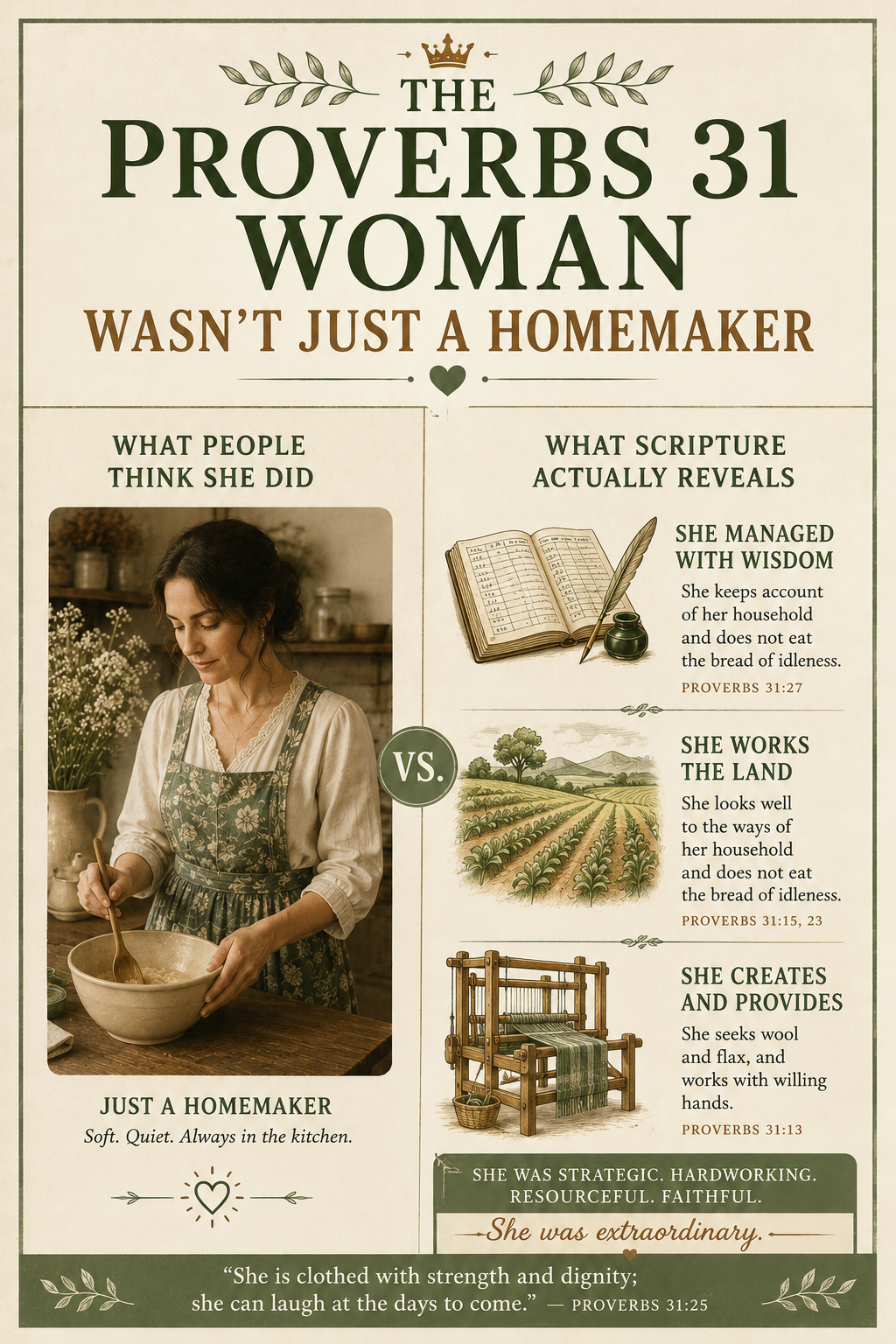
If you've spent any time in Christian women's circles, you've seen her everywhere. She's on coffee mugs, embroidered wall hangings, and the covers of devotionals, always pictured the same way: an apron-clad homemaker, kitchen spotless, children content, quietly managing her household while her husband is out in the world. The Proverbs 31 woman has become shorthand for a very specific, very narrow picture of Christian womanhood.
Here's the thing though. If you actually sit down and read the passage itself, rather than the version of her that's been passed down through Pinterest quotes and wall art, you'll find someone far more interesting, and honestly, far more capable, than the picture most of us grew up with. She's a real estate investor. She runs a textile business that sells wholesale. She's physically strong, financially savvy, and outspoken. Homemaking is part of her life, but it's nowhere close to the whole story.
Let's actually look at what this passage says.
The Passage Is a Poem, Not a Checklist
Before diving into her specific accomplishments, it helps to understand what kind of writing we're even looking at. The verses describing this woman form an acrostic poem in the original Hebrew, with each line beginning with a successive letter of the Hebrew alphabet, all the way through. That's a deliberate literary structure, the kind used for something meant to be memorized, treasured, and meditated on, not a literal daily to-do list for one specific woman to check off.
Some Bible scholars actually read this passage as a summary poem capping off the entire book of Proverbs, personifying wisdom itself in the form of a woman rather than describing one historical figure's biography. Whether you read her as a real individual, an idealized composite, or a poetic personification of wisdom, the takeaway is the same either way. This isn't a rigid checklist for every Christian woman to replicate exactly. It's a picture of what wisdom looks like when it's lived out.
How Did We End Up With Such a Narrow Picture?
If the actual text describes a businesswoman, investor, and community leader, it's worth asking how she got flattened down to an apron and a spotless kitchen in so much popular Christian culture. Part of it likely traces back to a mid-twentieth century ideal of domesticity that got layered on top of the passage over time, where "godly woman" and "stay-at-home housewife" became treated as nearly interchangeable terms in a lot of church culture, even though the biblical text never actually makes that equation.
It's a helpful reminder that we all read Scripture through the lens of our own culture and moment in history, sometimes without realizing it. Going back to what the passage actually says, rather than what centuries of tradition have quietly added to it, is worth doing with any well-known passage, not just this one.
She Was a Businesswoman, Not Just a Homemaker
Here's where most modern retellings quietly skip over some of the most striking verses in the whole passage. This woman works with wool and flax, and she doesn't just spin thread for her own household. She makes linen garments and sells them, and she supplies sashes to merchants for resale. That's not a hobby. That's a wholesale textile business, with actual trading partners and a supply chain.
The passage goes out of its way to describe her profits as good, using language that reflects genuine commercial gain rather than a small side project. This is a woman with multiple income streams, not someone whose entire identity was contained within the walls of her home.
She Was a Real Estate Investor
It gets even more surprising. The text describes her considering a field and then buying it, using earnings from her own hands to plant a vineyard on it. In the ancient world, land was one of the most significant investments a person could make, and this woman is described making that call herself, evaluating the opportunity and following through with her own resources.
This is a woman actively growing wealth and expanding her household's assets, not simply managing what already existed. If you've ever felt like ambition and financial savvy were somehow at odds with godly womanhood, this passage says otherwise.
She Was Strong, Diligent, and Hardworking
The poem doesn't shy away from her physical strength either, describing her arms as strong and her work as vigorous. She rises while it's still dark to provide for her household, and her lamp doesn't go out at night, a picture of steady, sustained effort rather than a single burst of energy. This isn't fragile or decorative. It's a woman who works hard, physically and practically, day after day.
She Watched Over Her Household and Refused Idleness
Alongside her business dealings, the passage also notes that she watches carefully over the affairs of her household and doesn't eat the bread of idleness. That phrase is worth pausing on. It's not condemning rest, since the same poem describes a woman who is clearly well-rested enough to work with strength and confidence. It's describing someone who is engaged and attentive, rather than checked out or passive, in whatever she's responsible for, whether that's her business ledger or her children's upbringing.
She Was Generous and Outward-Focused
For all her business success, this woman isn't described as hoarding her gains. She opens her hands to the poor and reaches out to those in need. Her wealth and hard work aren't ends in themselves. They're resources she uses to bless people outside her own household, a detail that's easy to miss when the focus stays narrowly on her domestic role.
She Was Prepared, Wise, and Unafraid of the Future
Rather than being anxious about hard seasons ahead, she's described as unafraid of snow for her household, because everyone in her care is well clothed and provided for. She's also described as clothed in strength and dignity herself, and able to laugh without fear at whatever the future holds. That's not naive optimism. It's the confidence of someone who has planned well, worked hard, and trusts that she and her household are ready for whatever comes.
She Was Known for Her Wisdom, Not Just Her Skill
One detail that often gets lost entirely is that this woman speaks with wisdom, and kind instruction is on her tongue. She's not silent, decorative, or purely domestic. She's a teacher and a source of wise counsel, someone whose words carried weight in her household and likely well beyond it.
Her Family Noticed and Said So
Near the end of the poem, her children are described as rising up to call her blessed, and her husband offers his own praise, saying she surpasses many other women. It's a tender detail, and it matters. All of her strength, business sense, and generosity didn't come at the expense of her family's affection. If anything, the poem suggests her family adored her precisely because of the fullness of who she was, not in spite of it.
It's worth noting too that this passage isn't only about a woman working outside typical domestic roles. Her family clearly mattered deeply to her, and she to them. The point was never to choose between ambition and family. It was to show what wisdom looks like when it touches every part of a life, business and home alike.
The Real Climax Isn't Her Résumé
After walking through everything this woman has built and accomplished, the poem lands on something surprising. It says that charm can be misleading and beauty doesn't last, but a woman who reveres God is the one who deserves genuine praise. After twenty-some verses describing her business acumen, strength, generosity, and wisdom, the passage doesn't end by praising her productivity. It ends by pointing past all of it to the posture of her heart toward God.
That's worth sitting with. All of her accomplishments, the business, the real estate, the strength, the wisdom, flow out of that deeper foundation rather than being the foundation itself. She isn't praised because she did enough. She's praised because her whole life, in every one of those areas, was oriented toward honoring God.
She's in Good Company
If a businesswoman investing in real estate feels surprising for a Bible passage, it helps to remember she's not alone. Scripture describes Lydia running a successful textile trade and hosting the early church in her home, and Deborah leading and judging a nation during a genuinely difficult season. None of these women fit into one narrow mold, and none of them were praised for staying small. They were praised for using what God gave them, fully and faithfully, wherever he placed them.
What This Actually Means for Us Today
If you've ever felt like Proverbs 31 was a standard you could never quite live up to, a superhuman homemaker who never messes up and always has it together, it might help to know that's simply not what the passage is describing. It's not a woman who does everything perfectly. It's a picture of wisdom in action, showing up through hard work, financial savvy, generosity, strength, and above all, a heart that fears the Lord.
That picture looks different depending on your season of life. For one woman, it might genuinely look like running a household and raising children full time. For another, it might look like running a business, investing wisely, or leading in her community, all while still caring deeply for her family. The specific tasks in this poem were simply what wisdom looked like in that particular ancient household. The posture underneath them, diligence, generosity, strength, and reverence for God, is what actually transfers to your life today, whatever your circumstances look like.
Different Christian traditions land in different places on exactly how to apply this passage to modern gender roles, and that's worth working through with your own church community rather than settling with a single blog post. But nearly everyone agrees on this much: reducing this woman to a spotless kitchen and a quiet demeanor sells the passage seriously short.
A Few Questions Worth Sitting With
Instead of a checklist to complete, consider a few honest questions this passage raises. Where in your life right now are you being diligent, whether that's a business, a home, a job, or raising children? Are you using whatever resources you have, time, money, skill, or strength, generously toward people outside your own household? Is your identity resting more on your accomplishments or on your reverence for God? And is there room in your own picture of godly womanhood for ambition, strength, and enterprise alongside care for home and family, rather than treating them as opposites?
There's no single right answer to any of these. The point is simply to let the actual passage, rather than the flattened version of it, shape how you think about your own life.
Frequently Asked Questions
Was the Proverbs 31 woman a real person?
It's genuinely debated. Some read her as a real, ideal woman being held up as an example, while others read her as a poetic personification of wisdom summarizing the whole book of Proverbs. Either reading points to the same underlying character qualities worth admiring.
Does Proverbs 31 mean women should run businesses instead of staying home?
Not exactly. The passage describes a woman who did both, managing her household and running a business, rather than choosing one over the other. It's less a rule about what every woman must do and more a picture of diligence, wisdom, and resourcefulness applied to whatever she was responsible for.
Why does the passage end by talking about fearing God instead of listing more accomplishments?
Because the point of the whole poem isn't really the accomplishments themselves. They're evidence of a deeper character trait, a life oriented around reverence for God, which the passage identifies as the true source of lasting praise.
Is it wrong to feel intimidated by the Proverbs 31 woman?
It's an extremely common reaction, but it often comes from reading the passage as a checklist rather than a poem describing wisdom in action. You're not meant to replicate her exact daily schedule. You're meant to grow in the same character qualities she embodies.
What does this passage say about ambition for Christian women?
It suggests ambition and godliness aren't opposites. This woman invests, builds, sells, and grows wealth, and the passage treats all of that as part of a wise, praiseworthy life rather than something to apologize for.
Why is the Proverbs 31 woman often paired with an acrostic structure?
The original Hebrew text forms an acrostic, with each line beginning with a successive letter of the Hebrew alphabet. That structure suggests the passage was meant to be memorized and treasured as a complete portrait of wisdom, rather than read as a literal daily schedule.
Does Proverbs 31 apply only to married women?
Not necessarily. Many of the character qualities described, diligence, generosity, wisdom, and reverence for God, apply just as much to a single woman, a widow, or anyone stewarding whatever responsibilities they've been given, not only wives and mothers.